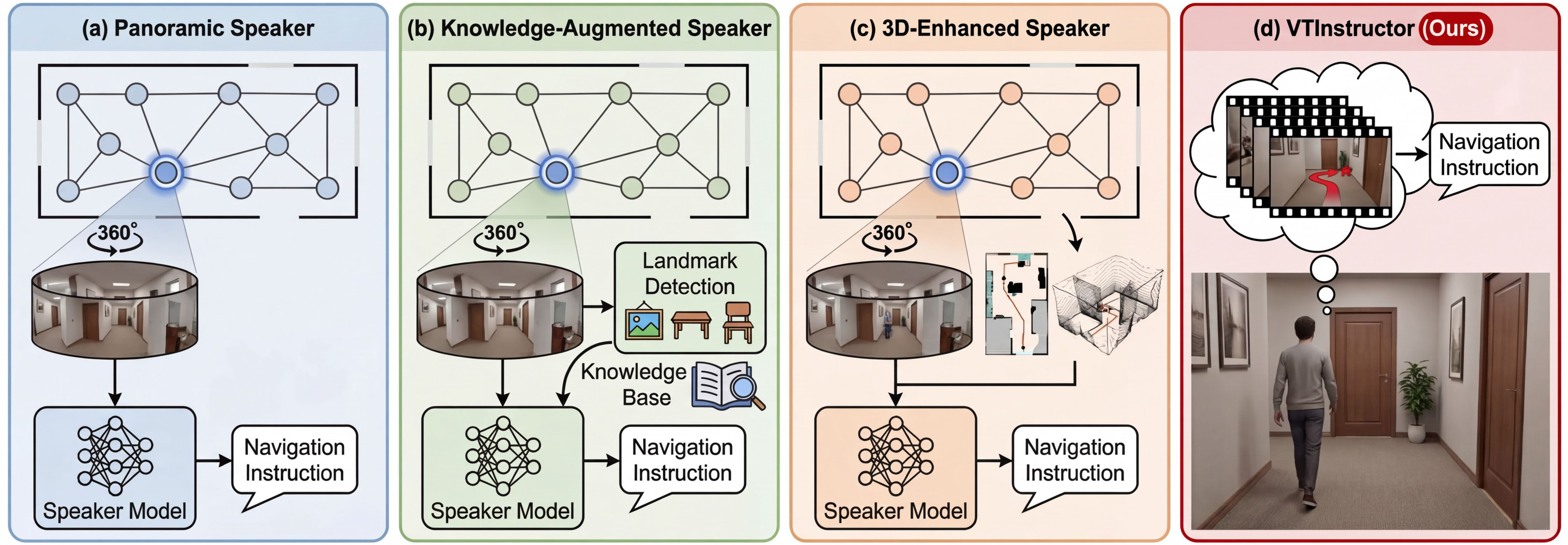
VTInstructor: Visual Trajectory Prompting for Navigation Instruction Generation in Continuous Environments
CFCS, School of Computer Science, Peking University
PrimeBot
PrimeBot
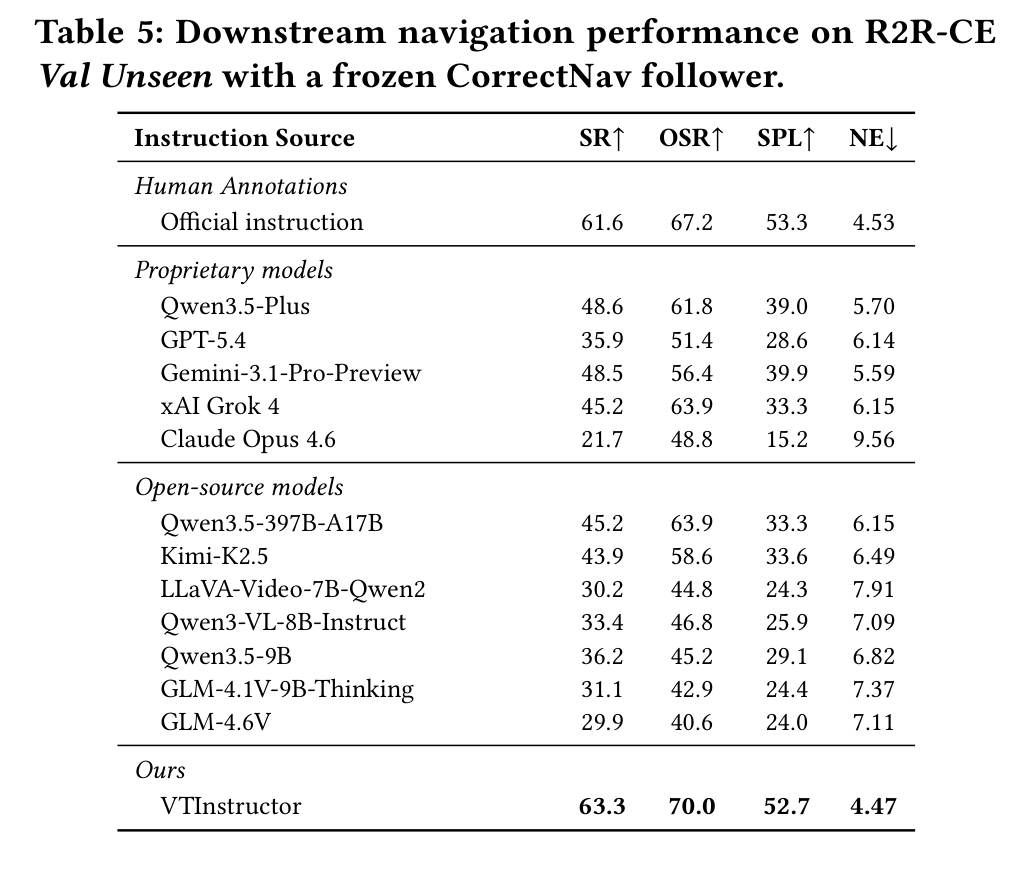
Navigation instruction generation from ego-centric RGB video in continuous environments is an important yet challenging task for human–robot interaction and scalable dataset construction. Prior instruction generators assume discrete viewpoint graphs with panoramic observations, where trajectory structure is explicit; in continuous environments, however, the agent receives only a dense RGB stream, making trajectory cues difficult to recover. We propose VTInstructor, the first VLN instruction generation framework for continuous environments. Our key idea is to convert implicit trajectory geometry into explicit visual trajectory prompts: EDTC condenses long RGB trajectories into navigation-critical keyframes, VTP overlays path, turn, and goal cues onto these anchors, VTMod injects the resulting trajectory signals into the visual encoder, and VT-GRPO further calibrates this spatial injection during training — all without requiring a navigation graph, pre-built map, or scene reconstruction. On the challenging R2R-CE and RxR-CE Val Unseen benchmarks, VTInstructor sets a new state of the art across all standard NLG metrics, surpassing the strongest baseline by +0.357 and +0.109 CIDEr, respectively. Beyond automatic metrics, VTInstructor-generated instructions raise a frozen follower's success rate to 63.3%, a +14.7 percentage-point gain over the best competing instruction source.
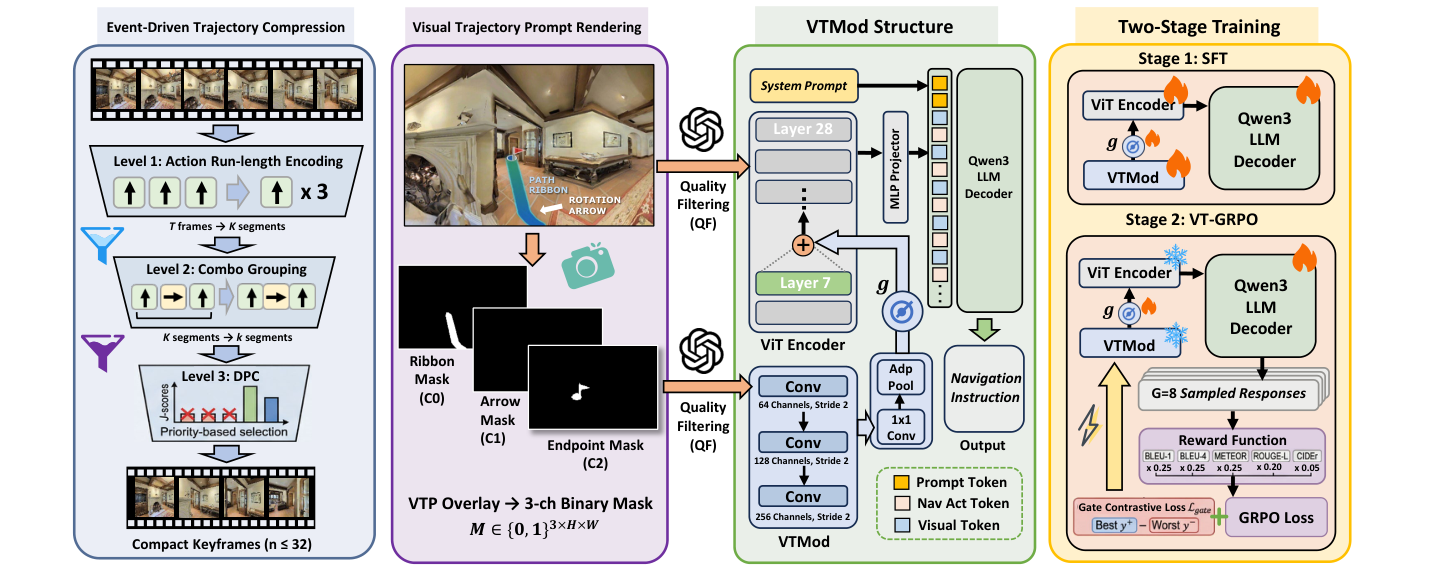
A three-level pipeline condenses a long RGB trajectory into navigation-critical keyframes (\(n \le 32\)): action run-length encoding, small-step combo grouping, and dynamic priority-based selection using a joint visual–geometric score.
Each keyframe is overlaid with a path ribbon, rotation arrow and endpoint marker, stored as a 3-channel binary mask \(M \in \{0,1\}^{3\times H\times W}\). GPT-based quality filtering keeps only spatially reliable instruction–keyframe pairs.
A lightweight encoder maps the mask to patch-aligned features injected into the ViT at layer 7 via per-token spatial modulation \(\mathbf{h}'_i = \mathbf{h}_i + \mathbf{g}\odot \mathrm{LN}(\mathbf{W}\mathbf{v}_i)\), where the gate \(\mathbf{g}\) starts near zero for lazy activation.
Reinforcement learning refines the gate and LLM using a weighted NLG reward over \(G{=}8\) sampled responses, plus a gate contrastive loss on the best/worst completions to sharpen which trajectory channels are amplified.
The Visual Trajectory Prompt renders the route back onto the ego-centric view. Watch how the same trajectory becomes far easier to read once the path ribbon, turn arrows and goal marker are overlaid.
Three R2R-CE trajectories, keyframe by keyframe. Left: raw ego-centric RGB. Right: the same frames with the Visual Trajectory Prompt — direction, turns and goal progress that were implicit in the pixels are now explicit.
Drag the bar to compare the Visual Trajectory Prompt on / off for the current keyframe, and click Next keyframe to move one step along the route.


Generated instruction: Walk out of the living room and into the kitchen. Turn left and walk into the bathroom. Stop in the doorway to the bathroom.
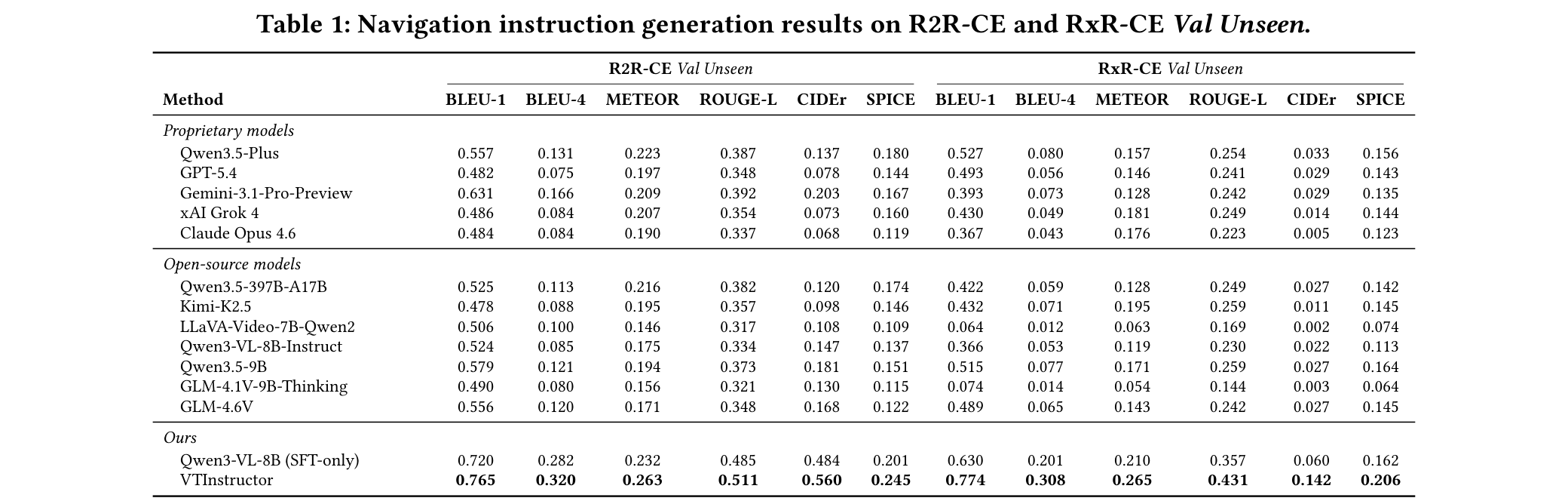
Navigation instruction generation on R2R-CE and RxR-CE Val Unseen. VTInstructor sets a new state of the art across all standard NLG metrics.

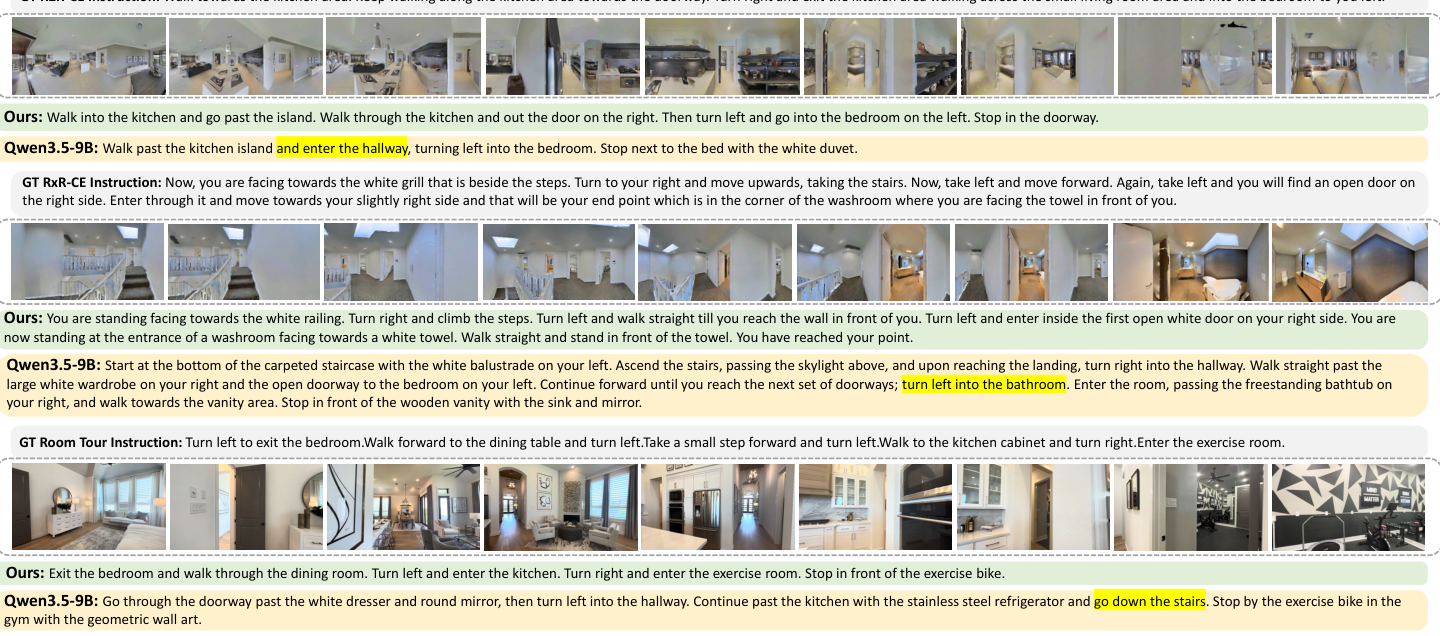
Compressed keyframes with VTP overlays (top) and instructions from the ground truth, the strongest baseline, and VTInstructor. Yellow marks factual errors (wrong turns, hallucinated landmarks).
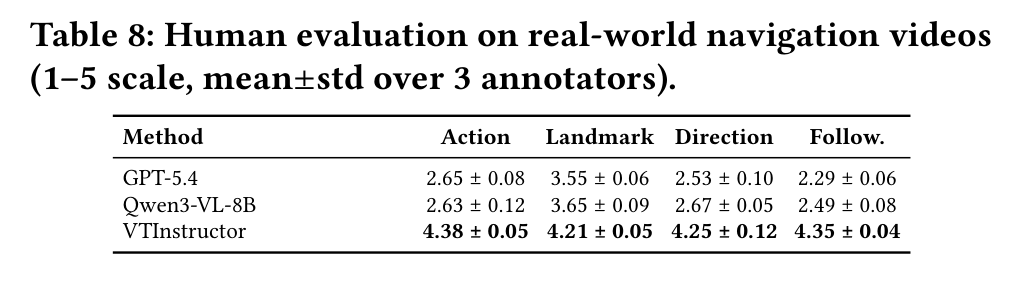
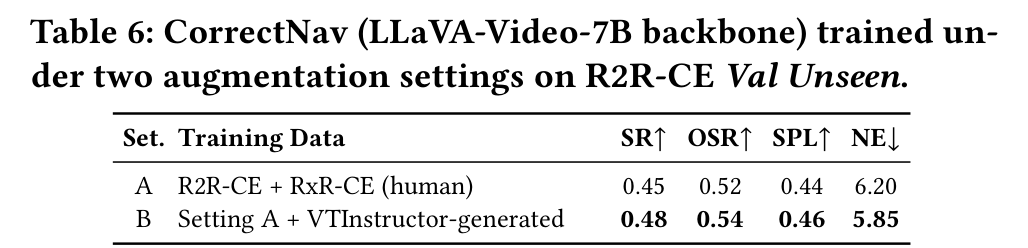
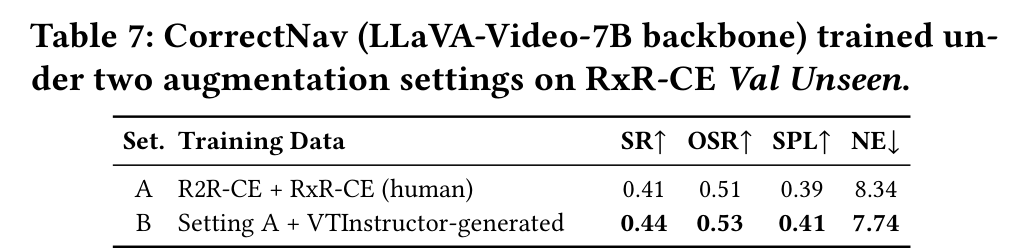
Beyond NLG metrics, VTInstructor-generated instructions improve real navigation: they beat human annotations as a frozen follower's guidance, augment training data, and win human preference on real-world videos. Adding VTInstructor-generated instructions to the training set of a frozen CorrectNav follower (LLaVA-Video-7B backbone) improves navigation on both benchmarks — a consistent gain on top of human data alone.
@misc{yang2026vtinstructorvisualtrajectoryprompting,
      title={VTInstructor: Visual Trajectory Prompting for Navigation Instruction Generation in Continuous Environments},
      author={Haolin Yang and Yuxing Long and Zihan Yang and Hao Dong},
      year={2026},
      eprint={2608.15284},
      archivePrefix={arXiv},
      primaryClass={cs.RO},
      url={https://arxiv.org/abs/2608.15284},
}